


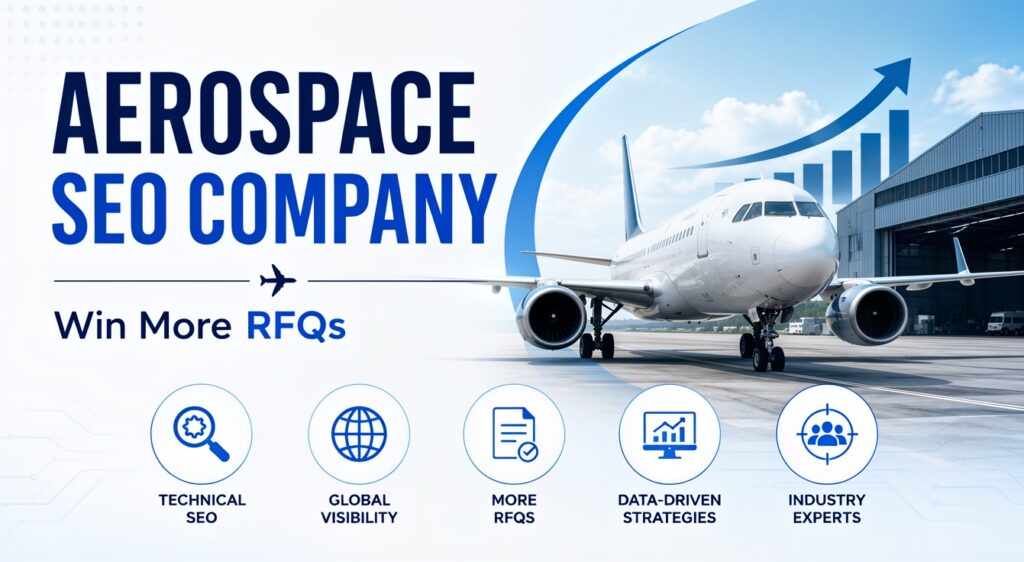
An aerospace SEO company is a specialized digital marketing partner that helps aviation, defense, and aerospace manufacturing businesses rank higher on Google, generate qualified RFQs, and get discovered by engineers, procurement officers, and OEM buyers who research suppliers online before ever picking up the phone. Unlike a generic SEO agency, an aerospace-focused partner understands long B2B sales cycles, low-volume high-intent keywords, ITAR and NDA constraints, and the technical vocabulary that aerospace buyers actually search for.
If you’re evaluating an aerospace SEO company for your manufacturing, MRO, avionics, or defense contracting business, this guide covers exactly what these agencies do, why the aerospace industry is still an underexploited SEO opportunity, what a strong service stack looks like, and how to choose a partner that can actually move revenue — not just rankings.
What Does an Aerospace SEO Company Actually Do?
An aerospace SEO company applies traditional search engine optimization — keyword research, technical SEO, content, and link building — but layers it with deep industry context. That means understanding the difference between a Tier 1 supplier searching for “precision CNC machining aerospace tolerances” and a defense procurement officer searching for “AS9100 certified avionics manufacturer.”
Core responsibilities typically include:
- Aerospace keyword research — mapping the exact phrases engineers, buyers, and procurement teams type into Google, including part numbers, certifications (AS9100, ITAR, NADCAP), and technical specifications.
- Aerospace technical SEO — fixing crawlability, site speed, structured data, and mobile performance so search engines can actually index complex product catalogs and spec sheets.
- Aerospace content marketing — publishing white papers, case studies, and technical guides that establish authority with a highly skeptical, engineering-minded audience.
- Aerospace B2B marketing — aligning SEO with long sales cycles, multiple stakeholders, and account-based marketing rather than one-click conversions.
- Aerospace lead generation — turning organic traffic into RFQs, quote requests, and sales-qualified leads, not just vanity traffic.
Why Aerospace Companies Need SEO in 2026
Aerospace has historically leaned on trade shows, personal relationships, and RFQ portals for new business. That’s changing fast. Procurement now starts online, well before a buyer ever contacts a sales rep.
A few numbers worth paying attention to:
| Data Point | Why It Matters |
|---|---|
| Most manufacturer leads now originate from organic search rather than outbound channels | Buyers are researching suppliers before contacting sales |
| Manufacturing marketers widely report higher conversion rates after investing in digital marketing | SEO and content directly influence deal flow, not just traffic |
| The majority of aerospace companies still under-invest in SEO | Early movers face far less organic competition than in consumer industries |
Because so few aerospace and aviation firms have serious organic search programs, the companies that do invest in aerospace search engine optimization now are securing rankings that will be extremely difficult for competitors to dislodge later. This is the single biggest argument for acting now rather than waiting.
Aerospace SEO vs. Generic SEO: What’s Actually Different
Not every SEO agency can execute this well. Aerospace SEO differs from standard B2B SEO in a few important ways:
Search volume is low, but intent is extremely high.
A generic agency chasing 10,000-search-per-month keywords will ignore the 20-searches-per-month term an aerospace buyer uses right before issuing a purchase order. An aerospace-savvy team knows those low-volume, high-intent phrases are where the revenue actually is.
Compliance and confidentiality constraints shape content.
NDAs, ITAR restrictions, and government contracts often limit what a company can publicly disclose. A capable aerospace SEO partner knows how to build authoritative, keyword-rich content around capabilities and processes without exposing sensitive program details.
Buyers are technical, and they can smell shallow content immediately.
Engineers and procurement specialists expect precise language tolerances, certifications, material specs not generic marketing copy. Thin, templated content actively damages credibility with this audience.
Sales cycles are long and multi-touch.
SEO content needs to support every stage: initial research, technical evaluation, and final procurement approval, often across several stakeholders inside the buying company.
Core Aerospace SEO Services to Look For
When comparing an aerospace SEO agency, look for a full-stack approach rather than a single tactic. A strong service stack usually includes:
1. Aerospace Keyword Research
Beyond obvious terms, this includes mapping keyword clusters by certification, part category, manufacturing process, and buyer role (engineer vs. procurement vs. program manager). Our own B2B SEO audit process starts here keyword and intent mapping is the foundation everything else is built on.
2. Aerospace Website SEO and Technical Optimization
Many aerospace and defense sites run on complex, JavaScript-heavy platforms or legacy CMS systems that quietly block search engines from indexing product and capability pages. Technical audits need to check crawlability, Core Web Vitals, structured data, and increasingly whether AI crawlers can even read the site at all.
3. Aerospace Content Marketing
Thought-leadership content performs disproportionately well in aerospace because so little of it exists. Effective formats include:
- Technical blog posts (e.g., composite materials in airframe construction)
- White papers on emerging capabilities (unmanned systems, additive manufacturing)
- Case studies showing measurable outcomes for past programs
- Landing pages built around specific manufacturing processes or certifications
4. Aerospace Local and National SEO
Even in a global industry, local search matters. A procurement manager searching “aerospace machine shop near Wichita” or “avionics supplier Southern California” is a high-intent buyer. Pairing local optimization with national authority-building the same approach we use for clients across our USA SEO services captures both types of demand.
5. Aerospace Link Building and Digital PR
Earning links and mentions from industry publications, aerospace associations, and trade press builds the kind of topical authority Google and increasingly AI search engines reward.
6. Aerospace Digital Marketing Beyond SEO
The strongest aerospace marketing agency partners layer SEO with complementary channels: LinkedIn, which remains the dominant platform for reaching engineers, procurement leads, and program managers (see our social media marketing services), plus online reputation management to protect brand trust in an industry where credibility is everything.
Aerospace SEO for AI Search (AEO / GEO)
Search itself is changing. Buyers increasingly ask ChatGPT, Google AI Overviews, and Perplexity questions like “which companies manufacture AS9100 certified titanium aerospace components” instead of typing a traditional Google query. This is sometimes called AEO (answer engine optimization) or GEO (generative engine optimization) — but the underlying discipline is still SEO, applied to a new set of surfaces.
To show up in AI-generated answers, aerospace content needs to:
- Answer the core question clearly within the first 40–60 words of a section, so it can be lifted as a self-contained citation
- Use question-based headings that mirror how buyers actually ask questions
- Include specific, sourced data points rather than vague claims
- Maintain clean heading structure and short paragraphs that AI crawlers can parse
- Be served through server-rendered pages, since AI crawlers generally can’t execute JavaScript
We treat this as a core part of modern visibility strategy it’s the same framework behind our AI search and SearchGPT optimization work, applied specifically to aerospace and aviation queries.
How to Choose the Right Aerospace SEO Company
Not every agency claiming aerospace expertise actually has it. Use this checklist:
- Ask for aerospace or manufacturing-specific case studies, not just generic B2B results.
- Confirm they understand compliance constraints ITAR, NDAs, and export control considerations shouldn’t be a surprise to them.
- Check whether they build full-funnel content, from top-of-funnel technical education to bottom-of-funnel RFQ-focused landing pages.
- Ask how they handle technical SEO for complex sites, including JavaScript-rendered platforms this is where many agencies fall short (see our breakdown of JavaScript SEO for why this matters).
- Ask directly about AI search visibility if an agency hasn’t started optimizing for AI Overviews and answer engines, they’re already behind.
- Review their reporting you should see keyword rankings, organic traffic, and RFQ/lead volume, not vanity metrics alone.
Common Mistakes Aerospace Companies Make with SEO
- Relying only on trade shows and referrals while competitors quietly build organic visibility.
- Publishing generic manufacturing content instead of aerospace-specific technical material.
- Ignoring technical SEO, leaving product and capability pages unindexed.
- Treating SEO as a short-term campaign rather than a compounding, long-term asset.
- Skipping AI search optimization entirely, missing an increasingly important discovery channel.
What Results Should You Expect?
Aerospace SEO is a long-term investment, not a quick-win channel most companies see meaningful ranking movement within 4–6 months and compounding returns over 12+ months as content authority builds. Because competition is comparatively low, well-executed aerospace SEO programs often deliver strong return on investment relative to more saturated B2B industries, particularly when measured against the lifetime value of a single major contract or long-term supplier relationship.
Frequently Asked Questions
An aerospace SEO company is a digital marketing agency that specializes in search engine optimization for aviation, aerospace manufacturing, and defense contracting businesses, combining traditional SEO with industry-specific keyword research, compliance awareness, and technical buyer content.
The terms are largely used interchangeably. “Aviation SEO” sometimes leans toward airlines, MRO, and flight-related services, while “aerospace SEO” often covers manufacturing, defense, and component suppliers but most agencies use both terms to describe the same specialized service.
Most aerospace companies begin seeing ranking improvements within 4–6 months, with stronger lead and RFQ growth compounding over 12 months and beyond, since aerospace keywords face relatively low competition.
Yes. An experienced aerospace SEO agency builds authority-driven content around capabilities, processes, and certifications rather than restricted program details, so companies can rank competitively without disclosing sensitive information.
It should. As buyers increasingly use tools like ChatGPT and Google AI Overviews to research suppliers, aerospace content needs to be structured for both traditional search rankings and AI-generated answers.
Why Work With Mavenj SEO for Aerospace SEO
Mavenj SEO combines the technical depth of a full-service SEO agency with a data-first, ROI-driven approach built for complex B2B and industrial sectors. From aerospace keyword research and technical SEO to AI search visibility, our team builds strategies designed around how aerospace buyers actually search and actually buy. Learn more about our team and approach, or reach out to discuss a strategy built specifically around your aerospace or aviation business.