


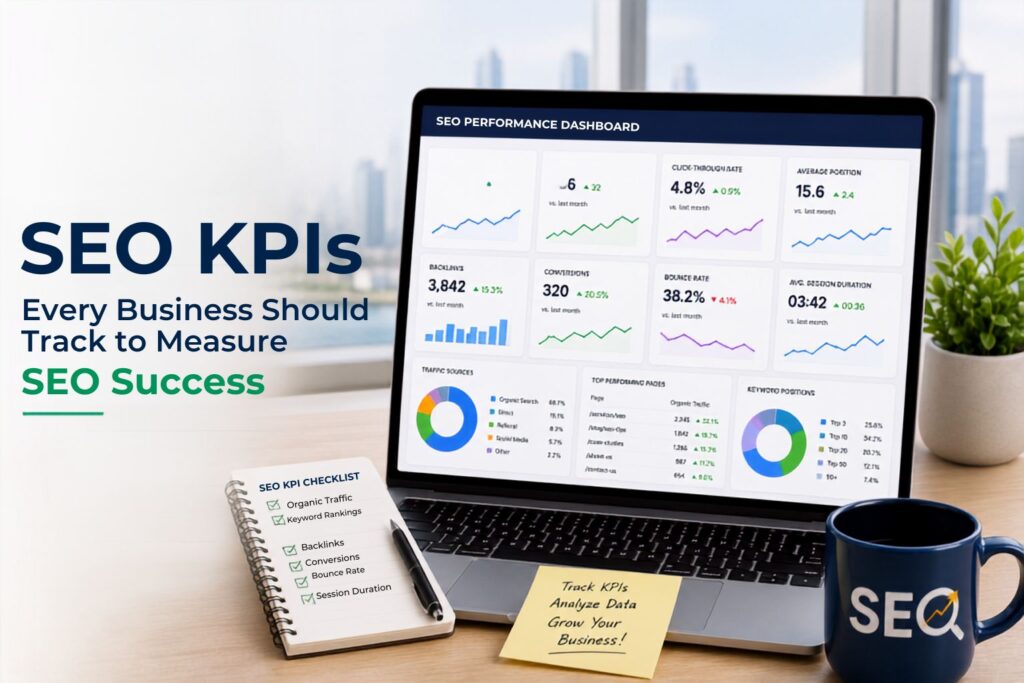
If you have ever asked an SEO agency “is this actually working?” and gotten a vague answer about rankings “improving,” you already know the problem. Most businesses invest in SEO without a clear system for measuring it, then judge results on gut feeling instead of data.
SEO KPIs (Key Performance Indicators) are the specific, measurable metrics organic traffic, keyword rankings, conversions, technical health, and ROI that show whether an SEO strategy is actually growing your business. Without them, you are paying for activity, not results.
This guide breaks down every SEO KPI that matters in 2026, how to track each one using Google Search Console and Google Analytics 4, and how to read a monthly SEO report the way an experienced strategist would. Wherever it helps, we will use examples from Dubai’s business landscape, since few markets make the case for rigorous KPI tracking as clearly as the UAE’s. Dubai alone is home to somewhere between 700 and 1,000 digital marketing agencies, all competing for the same pool of clients which means the businesses that win online are the ones actually measuring performance, not just buying “SEO services” on faith.
What Are SEO KPIs, Exactly?
SEO KPIs are quantifiable data points tied to specific business outcomes visibility, traffic, leads, and revenue rather than vanity numbers. A KPI is different from a generic “SEO metric” in one important way: a KPI is chosen because it maps directly to a business goal. Tracking 40 metrics in a dashboard is not KPI tracking; picking the 8–10 numbers that tell you whether the business is growing is.
For most businesses, SEO KPIs fall into five buckets:
- Visibility metrics — rankings, impressions, keyword coverage
- Traffic metrics — organic sessions, clicks, new users
- Engagement metrics — bounce rate, engagement rate, pages per session
- Conversion metrics — leads, form fills, calls, revenue
- Technical and authority metrics — Core Web Vitals, indexing, backlinks, domain authority
A good SEO reporting process tracks at least one KPI from each bucket. Reporting only on rankings as many freelancers and low-cost agencies still do hides whether traffic is actually turning into paying customers.
Why Rankings Alone Are the Wrong SEO Success Metric
For years, “did we hit position 1?” was treated as the finish line of SEO. That thinking is now outdated, for a very specific reason: the click-through rate for a first-place ranking has fallen sharply.
Independent 2026 studies analyzing millions of Google Search Console impressions put average position-1 organic CTR at roughly 27–28%, down from around 39.8% before AI Overviews became widespread a drop of roughly 30%. On informational queries where an AI Overview appears above the organic results, that decline is steeper still, with some studies recording CTR falling from around 1.4% to well under 1%. In other words: a business can rank #1 today and receive dramatically fewer clicks than the same ranking would have delivered two years ago.
| Position | Approx. Organic CTR (clean SERP) | Approx. CTR with AI Overview present |
|---|---|---|
| 1 | 35–40% | 15–20% |
| 2 | 15–19% | 10–13% |
| 3 | 9–12% | 6–8% |
| 4–5 | 5–10% | 3–6% |
| 6–10 | 1–4% | 1–3% |
(Ranges compiled from First Page Sage, GrowthSRC, Ahrefs, and Seer Interactive 2026 studies. Actual CTR varies by industry, device, and SERP features such as local packs or shopping results.)
This is exactly why a rankings-only report is no longer a reliable seo success metric. A business can look great in a rank tracker and still see flat revenue, because the traffic behind that ranking has changed. This is the core argument for tracking a full KPI set rather than a single number and it’s just as true for a Dubai real estate brand chasing “apartments for sale in Dubai Marina” as it is for a US SaaS company.
The Core SEO KPIs Every Business Should Track
1. Organic Traffic Growth
Organic sessions, organic clicks, and organic impressions (from Google Search Console and GA4) are the foundation metric of any SEO program. Track this monthly, not weekly SEO is a compounding channel, and week-to-week noise (algorithm updates, seasonality, indexing lag) makes short windows unreliable.
What to actually look at:
- Organic sessions/clicks — total visits arriving from unpaid search
- Organic impressions — how often your pages appear in search results, even without a click
- Trend over 3, 6, and 12 months — a single month tells you almost nothing
A Dubai example: a mid-size clinic group running healthcare SEO in the UAE typically sees organic impressions climb weeks before clicks do, because Google needs to build trust in newer pages before rewarding them with top positions. Businesses that panic and pull the plug at month two are usually cutting the program right before it pays off.
2. Keyword Rankings and Visibility
Keyword ranking tracking shows where your priority terms sit in Google, but the smarter version of this KPI is keyword visibility the percentage of your target keyword set ranking in the top 3, top 10, and top 20, tracked as a trend rather than a single snapshot.
For a Dubai retail brand, this might mean tracking visibility across commercial terms (“buy [product] Dubai”), informational terms (“best [category] in Dubai”), and branded terms separately, since each behaves differently and needs a different content response.
3. Click-Through Rate (CTR)
CTR (clicks) divided by impressions tells you whether your rankings are actually converting into visits. As the table above shows, CTR benchmarks shifted meaningfully in 2026 because of AI Overviews, so compare your CTR against your specific SERP context (with or without AI Overviews, local pack, etc.), not a generic industry number.
A page with high impressions but a CTR well below benchmark for its position usually has a weak title tag or meta description, not a ranking problem an easy, high-leverage fix.
4. Organic Conversions, Leads, and Goal Completions
Traffic without conversions is not SEO success it is a vanity metric. Set up Google Analytics 4 goal completions (form submissions, calls, WhatsApp clicks, bookings) segmented by organic traffic specifically, so you can see conversions attributable to SEO rather than blended across all channels.
For service businesses a law firm SEO Dubai campaign is a good example this usually means tracking:
- Contact form submissions from organic landing pages
- Click-to-call events on mobile
- Consultation booking completions
5. Bounce Rate and Engagement Rate
GA4 replaced the old bounce rate with engagement rate (sessions lasting 10+ seconds, with a conversion event, or with 2+ pageviews). A low engagement rate on a page ranking well is a signal of search intent mismatch — the page is ranking for a query it doesn’t actually answer well, which content optimization can usually fix quickly.
6. Backlinks and Domain Authority
Backlinks remain one of the strongest ranking signals Google uses, and domain authority (a third-party proxy score, not a Google metric) is a useful way to track your site’s overall link profile strength against competitors over time. Track referring domains and link quality trend, not raw backlink count — ten relevant, high-authority links outperform a hundred low-quality directory links.
7. Technical SEO Health
Core Web Vitals, page speed, crawl errors, and index coverage form the technical backbone of SEO performance. A technical SEO audit should be run quarterly at minimum, checking:
- Core Web Vitals scores (LCP, INP, CLS)
- Crawl errors and broken links
- Index coverage (pages indexed vs. submitted)
- Mobile usability
- Schema markup validity
A site can have excellent content and still underperform if these fundamentals are broken — this is the single most overlooked category in DIY SEO reporting.
8. Local SEO Metrics
For any business serving a physical location which describes a large share of Dubai’s economy, from hospitality to real estate to clinics local SEO reporting deserves its own KPI set:
- Google Business Profile views, calls, and direction requests
- Google Maps ranking position for target searches
- Review count and average rating
- NAP (name, address, phone) consistency across directories
Interestingly, the map pack behaves very differently from the organic blue links: 2026 data shows the CTR gap between map pack position 1 and position 3 is only around 2–3 percentage points, compared to a nearly 30-point gap in standard organic results. That means simply appearing in the map pack at all matters more than obsessing over the exact rank inside it a useful reframe for a Dubai travel agency or hospitality brand focused on local visibility.
9. SEO ROI
Ultimately, every KPI above should roll up into one number: SEO ROI. Calculate it as:
(Revenue attributed to organic traffic − SEO investment) / SEO investment × 100
This requires connecting GA4 conversion data to actual deal values or average order value a step many businesses skip, which is exactly why they can’t answer “is SEO working?” with confidence.
The Tools That Actually Measure These KPIs
Two free tools cover roughly 90% of what a business needs:
- Google Search Console — impressions, clicks, average position, CTR, index coverage, Core Web Vitals, mobile usability
- Google Analytics 4 — organic sessions, engagement rate, conversions, goal completions, revenue attribution
Beyond these, a rank tracker (for daily/weekly keyword position monitoring) and a backlink tool (for domain authority and referring domain tracking) round out a complete SEO analytics stack. Businesses working with an agency should ask to see raw GSC and GA4 data directly, not just a summarized PDF transparency here is one of the fastest ways to judge whether an seo agency in Dubai, or anywhere else, is reporting real performance.
How to Read a Monthly SEO Report Like a Strategist
A useful monthly SEO report answers four questions, in this order:
- Did visibility grow? (Rankings, impressions, keyword visibility trend)
- Did traffic grow? (Organic sessions and clicks, month-over-month and year-over-year)
- Did engagement quality hold up? (Engagement rate, pages per session)
- Did the business benefit? (Conversions, leads, revenue, ROI)
If the answer to question 1 is yes but question 4 is no for more than 2–3 consecutive months, that is the signal to change strategy not necessarily to abandon SEO, but to look at conversion rate optimization on the landing pages receiving traffic.
Common Mistakes Businesses Make When Measuring SEO Success
- Judging performance monthly instead of quarterly. SEO is a compounding channel; a single month of soft numbers rarely means the strategy failed.
- Tracking rankings only, ignoring conversions. A #1 ranking that doesn’t convert is not success.
- Mixing branded and non-branded traffic. Branded search growth often just reflects existing brand awareness, not new SEO wins.
- Comparing CTR against outdated 2019–2020 benchmarks. As shown above, the entire CTR curve shifted with AI Overviews use current data.
- No technical SEO baseline. Without a starting Core Web Vitals and index coverage snapshot, it’s impossible to prove technical improvements later.
- Ignoring local SEO KPIs for location-based businesses. A Dubai restaurant or clinic optimizing only for national rankings is solving the wrong problem.
A Simple SEO KPI Dashboard Framework
For most small and mid-size businesses in Dubai or anywhere else this is a workable starting set of KPIs to track monthly:
| Category | KPI | Source |
|---|---|---|
| Visibility | Keyword visibility (top 3 / top 10 / top 20 %) | Rank tracker |
| Traffic | Organic sessions, organic clicks | GA4, GSC |
| Engagement | Engagement rate, avg. session duration | GA4 |
| Conversion | Leads, form fills, calls from organic | GA4 |
| Technical | Core Web Vitals pass rate, index coverage | GSC |
| Authority | Referring domains, domain authority trend | Backlink tool |
| Local (if applicable) | GBP calls, direction requests, map pack rank | Google Business Profile |
| ROI | Revenue from organic ÷ SEO spend | GA4 + finance data |
Building this once, in a simple spreadsheet or a shared dashboard, turns SEO reporting from a monthly guessing game into an actual business scorecard.
Why Dubai Businesses Need to Track SEO KPIs Even More Closely
Dubai is one of the most competitive digital markets in the Middle East, and that competition directly changes how SEO KPIs should be interpreted. A few market realities make this clear:
- Agency density is high. Estimates put the number of digital marketing and advertising agencies operating in Dubai somewhere between 700 and 1,000, with more than 1,150 across the wider UAE. Roughly 97% of these are small or single-owner operations. In a market this crowded, businesses that can’t independently verify SEO KPIs are at the mercy of whichever agency’s report sounds most convincing.
- The market is bilingual and international. Campaigns frequently need to perform across English and Arabic-speaking audiences, plus international customers researching Dubai-based businesses from abroad. This means keyword visibility should be tracked separately by language and audience segment, not blended into one number.
- Local intent is unusually high-value. Searches like “dentist in Dubai Marina” or “SEO agency in Business Bay” carry strong commercial intent, which is exactly why local SEO KPIs Google Business Profile calls, direction requests, and map pack position deserve more weight in a Dubai SEO reporting framework than they might for a purely national or global business.
- Multi-industry competition inflates rankings noise. Because verticals like real estate, hospitality, healthcare, and legal services are all investing heavily in SEO simultaneously, ranking volatility is common. This makes trend-based reporting (3-month and 12-month views) even more important than in less competitive markets, where a single algorithm update might swing rankings less dramatically.
For a Dubai business evaluating whether an SEO company in Dubai is actually delivering results, the KPI framework in this guide doubles as a due-diligence checklist: ask to see organic session trends, not just rank-tracker screenshots; ask how conversions from organic traffic are tracked in GA4; and ask for a technical SEO audit baseline before the campaign started, so technical progress can be measured, not just claimed.
FAQs
Organic traffic growth, keyword visibility, and organic conversions matter most for small businesses, since they directly show whether SEO is generating leads relative to cost technical and authority metrics matter too, but mainly as inputs that drive those three.
Most businesses start seeing measurable movement in impressions and rankings within 3–4 months, with meaningful traffic and conversion growth typically appearing between months 4 and 6, and compounding further over 12 months. Competitive markets like Dubai, where hundreds of agencies compete for the same commercial keywords, often sit toward the longer end of that range.
This varies heavily by industry, but many service businesses see organic conversion rates between 2% and 5% for well-optimized landing pages, while highly competitive or expensive services may see lower rates offset by higher deal value.
Ranking position is still useful as one input, but it should never be tracked alone. Because AI Overviews have reduced click-through rates at every position, a strong ranking no longer guarantees strong traffic pairing rankings with CTR, traffic, and conversion data gives a far more accurate picture of SEO success.
Monthly reviews are useful for catching issues early, but strategic decisions like changing an SEO agency or overhauling a content strategy should be based on trends across at least one full quarter, since SEO results compound over time rather than shifting week to week.
Turning KPIs Into a Growth Strategy
Tracking SEO KPIs is only half the job — the real value comes from acting on what the data shows. If organic traffic is climbing but conversions aren’t, that’s a sign to revisit landing page experience or website design and development rather than chasing more rankings. If visibility is strong but local calls and Google Maps traffic lag, it’s a signal to tighten up Google Business Profile management, the way we approach it for clients through our SEO services covering technical, local, and content SEO under one roof.
Different industries also need different KPI weightings. A healthcare provider in the UAE should weight local SEO and trust signals heavily, a law firm in Dubai should weight consultation-form conversions, and a travel agency should weight seasonal keyword visibility and booking-page engagement. The KPI framework stays the same; the priority order shifts by business model.
If you’re currently getting an SEO report full of ranking screenshots and little else, that’s usually the clearest sign it’s time for a second opinion. Learn more about how we work, or browse more SEO guides on our blog to keep building out your own reporting framework.